Why Your Headache Might Be Coming From Your Neck
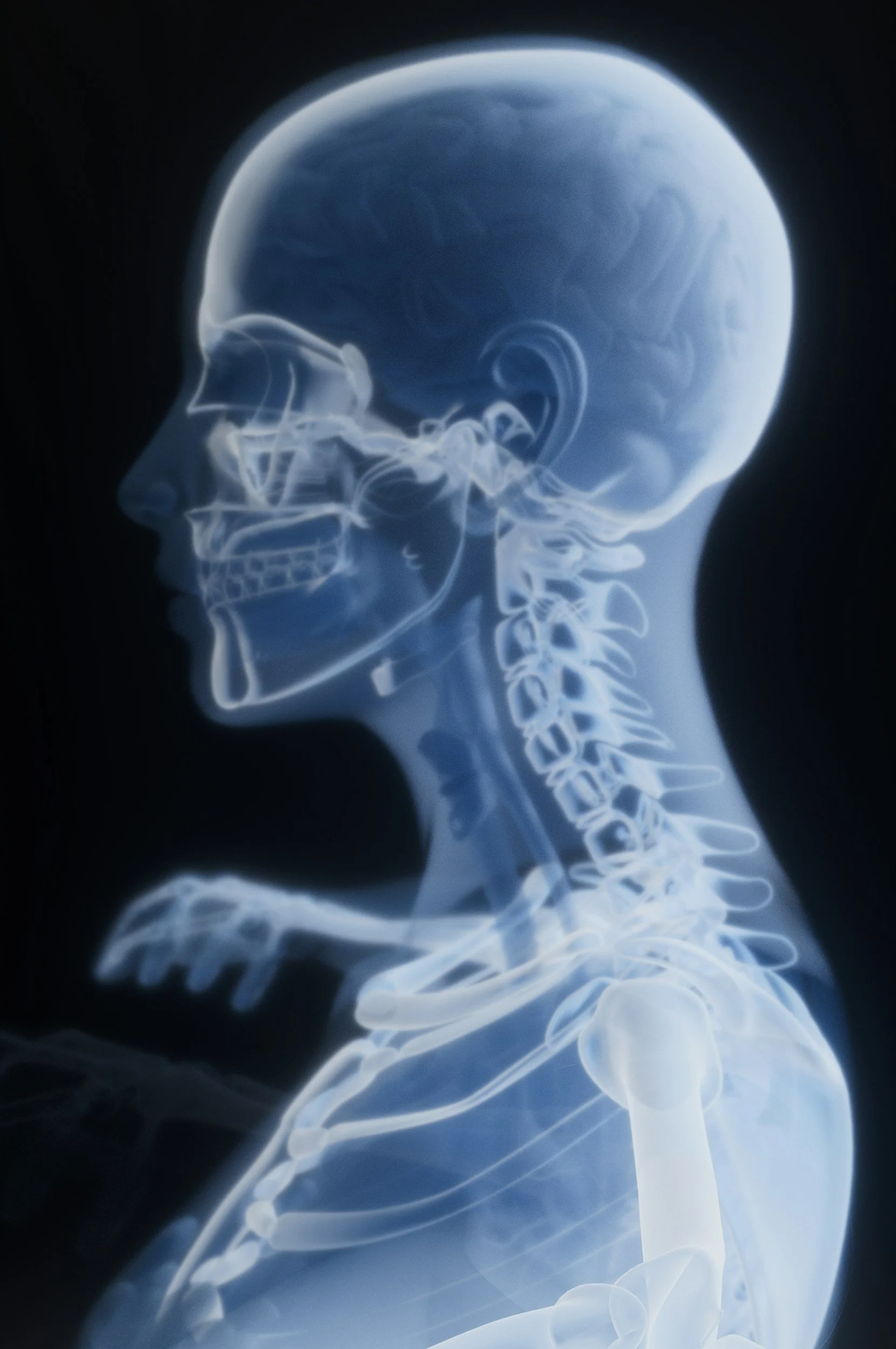
"The patterns you repeat most often are the ones your body will eventually reflect."
Let me ask you something before we start.
If you get headaches regularly, when did you last think seriously about your neck? Not just stretch it for thirty seconds, but actually consider that your neck might be the source, not just a bystander.
And if you're a practitioner, when a client comes in describing tight shoulders, a stiff neck, and headaches that keep coming back, how confident are you that you're finding everything that's relevant? Not just the obvious tension, but the jaw, the suboccipitals, the way they sit, the way they train, the patterns they've built over years without realising it?
Two different people. Same problem. Same anatomy. Same question: what's actually going on here?
That's what this post is about.
The first question isn't where it hurts, it's what you do all day
Before assessing anything physically, I want to understand how you use your body. Are you sitting at a desk for eight hours? Driving long distances? Standing, lifting, and holding things in the same position repeatedly? Are you on a screen, on the phone, looking down?
This matters because your body adapts to whatever you ask it to do most often. Muscles that work hard all day get tight. Muscles that never get used switch off. Over time, those patterns accumulate, and eventually they start talking to you. Usually through pain, stiffness, or headaches.
Once I have that picture, I assess more specifically to gather objective information. Then the job is connecting the dots, joining what I feel under my hands with what you've told me about your life, and making sense of it through anatomy and clinical experience.
It's not always about stillness; movement patterns matter too
Sustained posture and repetitive work are common culprits, but they're not the only ones. How you move, and whether you move well, matters just as much.
Poor exercise technique is a frequently overlooked cause of chronic neck tension and headaches, even in people who are otherwise fit and active. You don't need to be pushing to your limits for technique to become an issue. Sometimes it's simply a matter of not knowing what the correct form actually feels like in your body.
A straightforward example I've seen repeatedly, and experienced myself, is the barbell squat. A common mistake is positioning the bar too high on the lower cervical spine, which compresses the neck and forces it to carry a load it was never designed to handle. The bar should sit lower, resting across the upper thoracic spine and the shelf created by the rear deltoids and trapezius. It's a small adjustment in position but a significant difference in how the neck responds over time. Repeated sessions with the bar in the wrong place will load the cervical muscles chronically, and for some people, that's exactly what's driving their headaches.
The broader point is this: whether you're sitting at a desk, driving, or training in the gym, the patterns you repeat most often are the ones your body will eventually reflect. Assessment means looking at the full picture, not just where it hurts, but what you've been asking your body to do.
The neck-headache connection: What's actually happening
There's a well-established relationship between the cervical spine, your neck, and headaches. When the muscles and joints of the neck are under chronic load or tension, they can directly refer pain into the head. This is called a cervicogenic headache, and it's more common than most people realise.
The muscles most commonly involved are ones you've probably felt tightness in before: the upper trapezius running from your neck to your shoulders, the sternocleidomastoid (SCM) running along the side of your neck, and the suboccipital muscles sitting at the base of your skull just below the back of your head. When these muscles carry sustained tension, from posture, stress, repetitive movement, or all three, they develop trigger points that refer pain upward into the head.
The jaw adds another layer. The temporalis, masseter, and pterygoid muscles, all involved in chewing, clenching, and jaw movement, sit in close anatomical relationship to the cervical region. Jaw tension and neck tension frequently coexist, and treating one without addressing the other often produces incomplete results.
When all of these areas are assessed and treated together, the results are dramatically better than treating headaches in isolation.
Treatment works. But it's only part of the answer.
In most cases, releasing the key muscles around the neck, shoulders, and jaw produces significant and immediate relief. That part is usually straightforward when you know what you're looking for and where to look.
The harder part is what comes after.
A single treatment can remove the pain. But if the root cause, the posture, the repetitive pattern, the way you hold tension in your body, doesn't change, the headaches will return. This is where I spend a lot of time with clients: explaining what's happening, why it's happening, and what you can actually do about it. Not just stretches to do at home, but a genuine understanding of how your body is responding to how you live.
There's another layer worth understanding here; no muscle works alone. Every movement your body makes is a collective effort. Some muscles do the primary work, others stabilise, support, and coordinate around them. The neck and shoulder muscles involved in headaches don't exist in isolation; they're part of a larger system that includes how you breathe, how you hold your trunk, and how your shoulders move.
This is why targeting one specific muscle in isolation, the classic "I just need to strengthen my neck" approach, often misses the point. If the supporting muscles around it aren't working properly, the primary muscles end up compensating, overloading, and eventually complaining. It's the same reason that obsessing over your six-pack while neglecting everything around it rarely produces the core stability people are actually after.
Understanding this shifts the focus from "fix this muscle" to "how is this whole system working together", and that's usually where the real answers are.
Every person is asymmetric in a different way. Every person uses their body differently. Two people with identical symptoms might need completely different approaches once you understand what's driving them. That's what makes this work interesting, and why a thorough assessment always matters more than a standard protocol.
What to look for in your own body
If you regularly experience headaches alongside neck stiffness or shoulder tension, it's worth considering whether the two are connected. Some questions worth sitting with:
Do your headaches tend to start at the base of the skull or behind one eye?
Do they get worse after long periods of sitting, driving, or screen time?
Do you clench your jaw, especially under stress?
Does your neck feel stiff or restricted when you turn your head?
Do you train regularly, and have you ever been coached on your technique, or mostly figured it out yourself?
If several of those resonate, the cervical region and jaw are almost certainly involved, and addressing them directly is likely to make a meaningful difference.
A note for fellow practitioners
If you work in remedial massage or physiotherapy, this presentation is one you'll see constantly. The anatomy is well understood, but in practice, confidently palpating the suboccipitals, scalenes, and pterygoids, and knowing exactly how to apply the right technique to the right tissue at the right moment, takes deliberate hands-on practice that most courses don't provide enough of.
In May 2026, I'm running the first workshop in the Advanced Palpation & Manual Therapy series in Sydney, a full day focused entirely on the Head, Jaw & Cervical region. If that's a gap you want to close, details are at fitmuscletherapy.com.
I'm genuinely curious, whether you're someone who lives with this kind of tension, or a practitioner who treats it: what's the piece of this puzzle that you find hardest to resolve? The assessment, the treatment, getting clients to change their habits, something else entirely?
Reply by email, leave a comment, or just sit with the question. Either way, I hope something here was useful.
For clients
Living with pain you've learned to work around?
Remedial massage and dry needling targeted at the muscles driving your symptoms, not just where it hurts. Because the longer it's ignored, the harder it becomes to unwind."
Book a sessionFor therapists
Ready to trust what your hands are telling you?
FMT Academy workshops are built around one idea: clinical reasoning is a loop, not a checklist. Full-day hands-on sessions for remedial massage therapists and physiotherapists.
Explore the workshop series-
Fernández-de-las-Peñas C, et al. Conservative physical therapy management for the treatment of cervicogenic headache: a systematic review. Journal of Manual & Manipulative Therapy. 2014. PubMed pubmed.ncbi.nlm.nih.gov/24421621
Jull G, et al. Cervicogenic headache. Cephalalgia. 2023. — This research validated that a pattern of reduced cervical motion, upper cervical joint signs, and impaired deep neck flexor function accurately identifies cervicogenic headache and differentiates it from migraine and tension-type headache. PubMed pubmed.ncbi.nlm.nih.gov/37301672
De Laat A, et al. Correlation between cervical spine and temporomandibular disorders. — This study documented neuroanatomical interconnections and neurophysiological relationships between the orofacial area and the cervical spine, finding significant correlations between TMD and cervical dysfunction particularly at C0–C3 levels. PubMed pubmed.ncbi.nlm.nih.gov/15490776
Wierzbicka-Damska I, et al. Reinvestigation of the dysfunction in neck and shoulder girdle muscles as the reason of cervicogenic headache among office workers. — This study found that dysfunction of the trapezius muscle was most responsible for cervicogenic headache in office workers, supporting the clinical relevance of addressing postural and occupational loading patterns. PubMed pubmed.ncbi.nlm.nih.gov/22888759